47-Day Longevity Intervention: A Real Case Study on Body Composition Transformation


Key Takeaways
Body composition—not just weight—is the most accurate indicator of health progress, especially when measured with medical-grade tools like Seca BIA.
Within 47 days, measurable improvements can occur across fat loss, muscle gain, and visceral fat reduction simultaneously.
Advanced analysis using Seca 555 provides clinically validated insights, enabling a precise, data-driven approach to health and longevity.
Can meaningful body transformation really happen in just over a month—and how do you know if it is truly improving your health?
Many people still rely on weight as the primary indicator of progress. However, in modern longevity science, this approach is increasingly recognised as incomplete—and often misleading. What truly matters is body composition: the balance between fat mass, muscle mass, and metabolically active tissue.
With the use of advanced technologies such as Seca BIA (Seca 555), clinicians can now measure these changes with clinical precision. This makes it possible to understand not just how much weight is lost, but what kind of weight is lost—and what is gained.
To better understand how this works in practice, let’s explore a real 47-day case study from Longevity Clinic Malaysia, where a structured, personalised longevity intervention led to measurable improvements in body composition, metabolic health, and overall health scoring.
What Is Body Composition and Why It Matters
Body composition refers to the proportion of different tissues and components that make up the body. Advanced medical-grade body composition analysis provides deeper insight into health beyond standard weight or BMI measurements.
Parameters commonly measured include:
Fat mass
Skeletal muscle mass
Visceral fat
Body water
Phase angle
Unlike conventional body fat scales, medical-grade systems such as Seca BIA provide more precise, multi-compartment analysis to support personalised health and longevity interventions.
Why Body Composition Matters
Metric | Why It Matters |
Fat mass | Excess body fat is linked to metabolic and cardiovascular risk |
Skeletal muscle mass | Supports strength, mobility, metabolic health, and healthy ageing |
Visceral fat | High visceral fat is associated with increased chronic disease risk |
Body water | Reflects hydration status and overall cellular function |
Phase angle | Indicates cellular health, recovery capacity, and overall vitality |
A person may appear healthy based on body weight alone, yet still have poor metabolic health or unfavourable body composition. Tracking these parameters provides a clearer understanding of overall wellness, functional health, and longevity potential.

Case Overview: Measurable Outcome in 47 Days
Profile:
Male, 46 years old
Generally healthy
Active gym-goer
Objective: Increase muscle mass while reducing body fat and visceral fat
The individual underwent a personalised longevity intervention programme, guided by Dr. Andes and continuously monitored using Seca BIA technology.

Baseline vs After 47 Days: What Changed?
1. Weight Change (Surface-Level Indicator)
Metric | Before | After | Change |
Weight | 76.7 kg | 72.5 kg | ↓ 4.2 kg |
While this reflects overall weight reduction, it does not fully explain the quality of the transformation.
2. Fat Mass Reduction (Primary Driver of Progress)
Metric | Before | After | Change |
Fat Mass | 19.5 kg | 15.66 kg | ↓ 3.84 kg |
More importantly, the data shows that the majority of weight loss came from fat mass rather than muscle, which is a key marker of effective and sustainable health improvement.

3. Visceral Fat Reduction (High-Impact Health Marker)
Metric | Before | After | Change |
Visceral Fat | 2.4 L | 2.1 L | ↓ 0.3 L |
Visceral fat is strongly linked to:
Cardiovascular risk
Insulin resistance
Chronic inflammation
A reduction of 0.3 litres within 47 days is clinically meaningful and reflects a positive shift in internal health.

4. Muscle Mass Gain (Critical Longevity Indicator)
Metric | Before | After | Change |
Skeletal Muscle Mass | 25.31 kg | 26.1 kg | ↑ 0.79 kg |
This is one of the most critical outcomes of the intervention.
Despite an overall reduction in body weight, the subject gained muscle mass—highlighting a successful body recomposition process. This is a key objective in longevity-focused programmes, where preserving and building muscle is essential for long-term health.

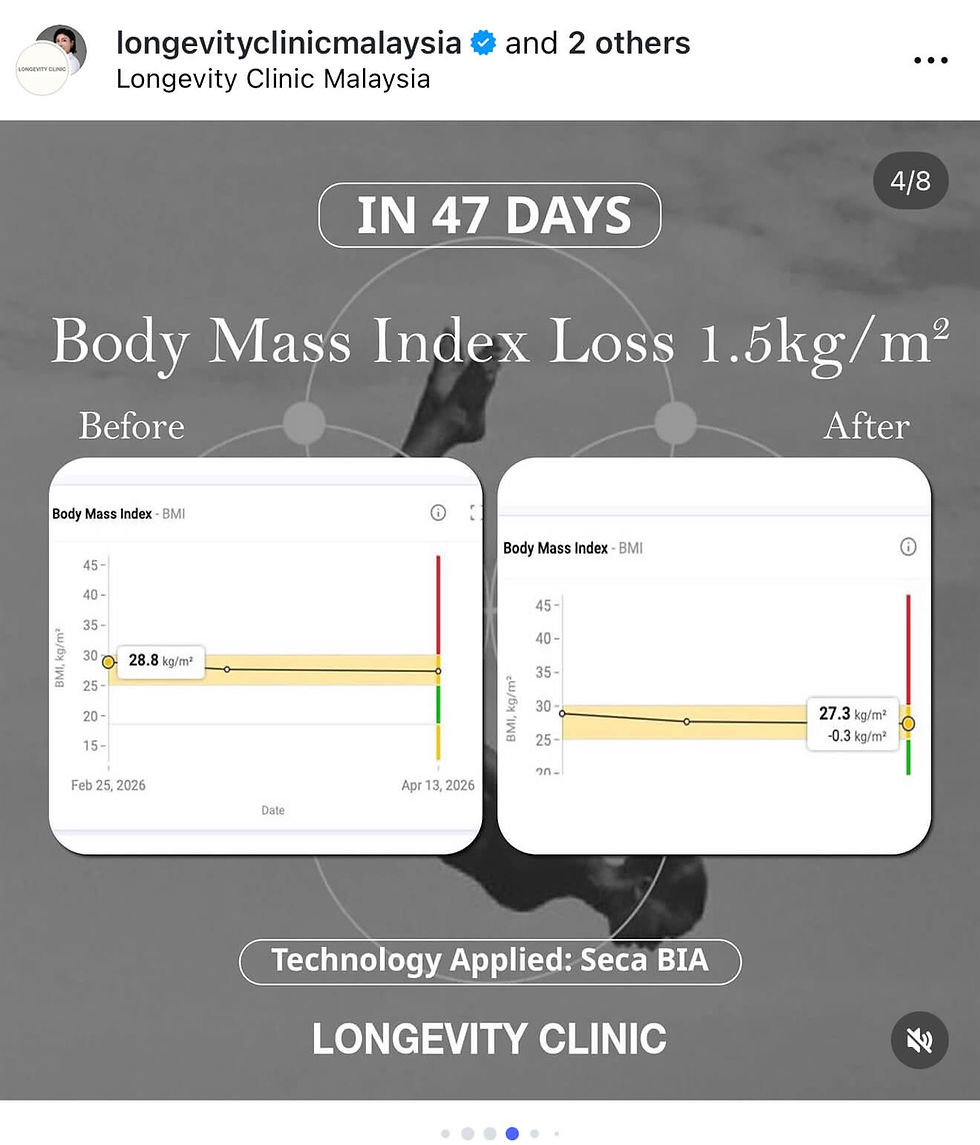
5. BMI Improvement (Supporting Metric)
Metric | Before | After | Change |
BMI | 28.8 kg/m² | 27.3 kg/m² | ↓ 1.5 kg/m² |
While BMI provides general context, it becomes significantly more meaningful when interpreted alongside detailed body composition data.
6. Longevity Score Improvement (Overall Health Progress)
Metric | Before | After | Change |
TRU Body Score | 94 (Bronze) | 103 (Silver) | ↑ Level upgrade |
The improvement from Bronze to Silver reflects broader gains in:
Metabolic health
Body composition balance
Functional performance
The Role of Seca BIA (Seca 555)
To accurately capture these changes, reliable measurement is essential—this is where advanced tools like Seca BIA play a critical role.
Why Seca 555 Stands Out?
Feature | Benefit |
Multi-frequency BIA | High accuracy measurement |
Segmental analysis | Tracks arms, legs, and torso individually |
Visceral fat measurement | Quantifies internal fat precisely |
Clinical validation | Reliable for medical and research use |
Unlike standard body fat scales, the Seca 555 provides clinically validated, reproducible data, enabling practitioners to track real physiological changes over time.
What Seca 555 Measures?
Parameter | Insight Provided |
Fat mass & fat % | Overall and regional fat distribution |
Skeletal muscle mass | Muscle health and balance |
Visceral fat | Internal fat linked to disease risk |
Total body water | Hydration and cellular status |
Phase angle | Indicator of cellular health |
Segmental analysis | Arms, legs, and torso breakdown |
These insights make it possible to identify meaningful health improvements that are not visible through weight alone.
The Key Concept: Body Recomposition
This case is a clear example of body recomposition.
What Happened
Fat mass decreased significantly
Muscle mass increased simultaneously
Weight reduced moderately
Why This Matters
Factor | Impact |
Fat loss | Improves metabolic health |
Muscle gain | Supports strength and longevity |
Visceral fat reduction | Lowers disease risk |
This combination represents a high-quality transformation, rather than simple weight loss.
What This Means for Health and Longevity
Improving body composition has direct implications for long-term health, including:
Better cardiovascular health
Improved insulin sensitivity
Higher energy and performance levels
Greater resilience to ageing
Rather than focusing purely on aesthetics, this approach prioritises functional health and long-term wellbeing.
Final Thoughts
This 47-day case study highlights a key principle in modern longevity care: meaningful transformation is not defined by how much weight you lose, but by what changes within your body.
With the use of Seca BIA (Seca 555), it becomes possible to track:
Fat loss
Muscle gain
Visceral fat reduction
Overall health progression
This data-driven approach represents the future of health optimisation and longevity medicine.
Ready to Measure What Truly Matters?
If you are still relying on a standard body fat scale, you may not be seeing the full picture of your health.
Discover how advanced body composition analysis using Seca BIA and personalised longevity interventions at Longevity Clinic Malaysia — a Functional Medicine Brand Leader in Malaysia, can help you achieve measurable, meaningful results.
👉 Visit https://longevityclinic.asia/ to begin your transformation today.
1. What is body composition analysis?
Body composition analysis measures the different components that make up the body, including fat mass, skeletal muscle mass, visceral fat, body water, and cellular health indicators. Unlike body weight or BMI alone, it provides a clearer picture of overall health, metabolic risk, and longevity potential.
2. Why is body composition more important than body weight?
Body weight only shows how heavy a person is, but it does not show whether the weight comes from fat, muscle, water, or other tissues. Body composition is more useful because it helps identify whether a person is losing fat, gaining muscle, reducing visceral fat, and improving overall metabolic health.
3. What is body recomposition?
Body recomposition refers to the process of reducing fat mass while increasing or preserving muscle mass. This is different from simple weight loss because the focus is not just on becoming lighter, but on improving the quality and balance of body tissues.
4. Can body transformation happen in 47 days?
Yes, meaningful body composition changes can happen in 47 days when the programme is structured, personalised, and properly monitored. In this case study, the individual reduced fat mass, lowered visceral fat, gained skeletal muscle mass, and improved their overall longevity score within 47 days.
5. What is Seca BIA? How is Seca BIA different from a normal body fat scale?
Seca BIA is a medical-grade bioelectrical impedance analysis system used to measure body composition. The Seca 555 can assess parameters such as fat mass, skeletal muscle mass, visceral fat, body water, phase angle, and segmental body composition to provide deeper health insights.
Unlike standard body fat scales, Seca BIA provides more advanced, clinically validated body composition data. It uses multi-frequency and segmental analysis to measure different areas of the body more precisely, making it more suitable for medical, longevity, and health optimisation programmes.
Comments